OK, latest fad that might become routine – Yogurt*.
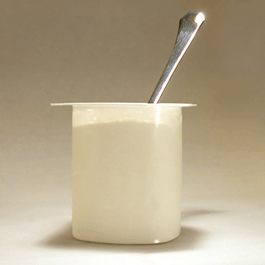 It’s one of those things we’ve always thought about but never ventured into.
We’ve been given an Easiyo Yogurt maker, and have started ‘growing our own’.
We have previously spent about £4.50 a week on yogs for the four of us.
We now make a kilo of yog for £2.50 – that lasts us the week.
The processed yog we bought previously might contain:
- Modified food starch, corn starch: Used as a stabilizer, thickener and emulsifier. This gives yogurt an extra creamy texture.
- Gelatin or Pectin, used as a thickener.
- Potassium sorbate: A preservative.
- A significant amount of sugar.
- Aspartame: An artificial sweetener.
- Fructose syrup (HFCS): A sweetener.
- Tricalcium phosphate: A calcium supplement.
- Whey Protein Concentrate.
- Sodium Citrate.
- Malic Acid.
- Colourings? and flavourings?
The yogs we are now growing contain:
- Each sachet contains only milk powder and live yogurt making probiotic strains of bacteria.
- Then… whatever fruit and honey etc. we put in it. (Rhubarb from the garden this week)
The milk powder is spray dried which means that only the water content is removed. Once you add water, it is the closest thing you can get to pure fresh milk.
Your yogurt is made over a range of temperatures so that each bacteria has its “moment in the sun” when the temperature is just right for optimum growth of that particular bacteria.
It’s quick and easy! No pre-heating of milk. No electrics, just make use of boiling water.
I guess we’ll see how long this fadtine lasts.
Note: Every day, 1.3million unopened yogurt pots are dumped…
*In English, there are several variations of the spelling of the word, including yogurt, yoghurt, yoghourt, yogourt, yaghourt, yoghurd, joghourt, and jogourt. In the United Kingdom and Australia, yogurt and yoghurt are both current, yoghurt being more common while yogurt is used by the Australian and British dairy councils, and yoghourt is an uncommon alternative.











 Jules P Richards