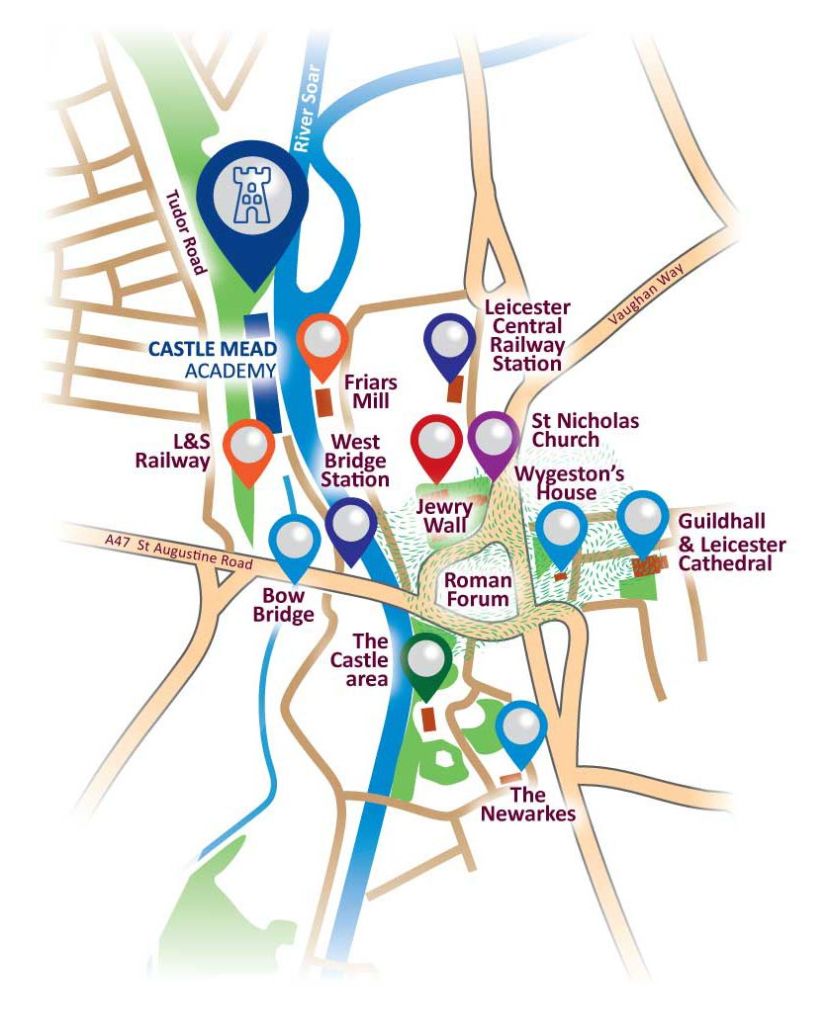
As part of the graphic design I provide supporting teaching and learning at Leicester’s Castle Mead Academy, I was asked if I might create a graphic that visualises “Two Thousand Years of History within ten minutes walk of Castle Mead Academy”.
I’ve recently completed educational graphic timelines for History, Computer Science and Art.

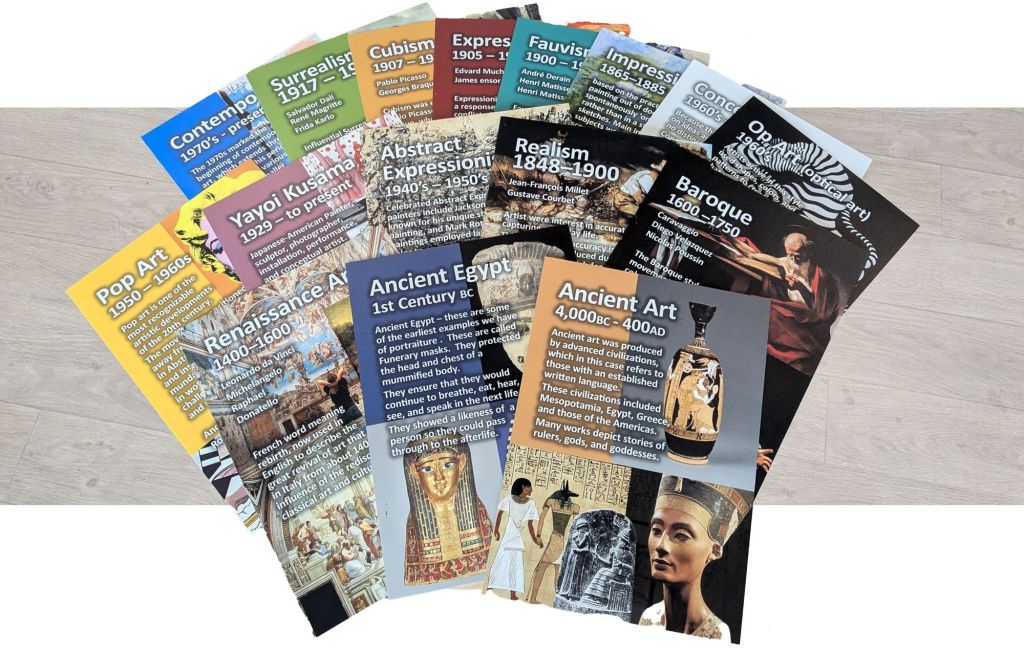

Colin Hyde from University of Leicester’s Oral History Archive saw these and suggested the ‘two thousand years’ idea.
Castle Mead Academy is situated in the heart of Leicester, as you can see history is on its doorstep; from the Jewry Wall Roman remains through to remains of the 19th Century Leicester’s Central Railway Station.

Thanks to Colin for the concept idea and the content.
Leicester City Council has compiled a wealth of images and information in their Story of Leicester project here: story-of-leicester
Their Heritage Panel Trail brings Leicester’s 2,000 years of history to life with now 350 colourful information panels now installed on the city’s streets, more info here: heritage-panel-trail
Two Thousand Years of History within ten minutes walk of Castle Mead Academy.
Before the Romans before 47AD
Leicester was the primary dwelling of the Corieltauvi tribe who lived around the River Soar in the area that is today beneath St Nicholas Circle, Jubilee Square and Bath Lane.
The Romans 47 – 500 AD
Although we can’t see it, the Roman forum was under St Nicholas Circle. What we can see at the Jewry Wall is the remains of the main bath house in Roman Leicester.
After the Romans 500 – 1066 AD
St Nicholas Church was consecrated in 879and contains Roman tiles in its tower.
The Normans 1066 – 1154 AD
The castle motte was built in 1068 and is the huge mound that the Normans built to support a wooden castle soon after they invaded in 1066.The Castle Area contains the Norman motte, the Great Hall/Leicester Castle 1150, St Mary de Castro Church 1107,and the Turret Gateway 1423.
Medieval Leicester 1066 – 1714 AD
Bow Bridge, the original bridge, shaped a bit like a bow, was built c.1350. The Newarkes contains Trinity Hospital founded in 1330,The Newarke Houses Museum c1511 and 1583, the Magazine c.1400. Wygeston’s House comprises a timber hall of around 1490; a brick block of 1796 which replaced an earlier timber shop and chamber;and a Victorian (1800s) wing standing on the site of the medieval kitchen.Leicester Cathedral which dates from 1086, and the Guildhall which was built in 1390.
Georgian Leicester 1714- 1837 AD
Castle Mead and the Rally Park are built on the site of the Leicester and Swannington Railway (L&SR). This was one of England’s first railways, built to bring coal from West Leicestershire collieries to Leicester, where there was great industrial demand for coal. The line opened in 1832.
The canal was completed in 1794 and Friars Mill, one of the earliest factories in Leicester, was built in the same year.
Victorian Leicester 1837 – 1901 AD
The site of West Bridge Station, was part of the Leicester-Swannington Railway. There was no platform at the original station and passengers had to climb aboard using steps and handrails attached to carriages. A narrow passenger platform was eventually created in 1876. By 1893 a new purpose-built station had been constructed next to Tudor Road.
The streets to the west of Castle Mead around Tewkesbury Street were built through the 1880s to the 1900s. There is a KingRichard III theme to several of the street names, such as Tudor Road.
Leicester Central Railway Station was built in 1899 and is now Lane7. The station was part of the Great Central Railway’s London Extension linking Nottingham with Marylebone in London.
There’s an ‘around the block’ video, made from a cycle helmet cam here:
#Graphic #Repro, it’s what I do.
If I can help you visualise something. Drop me a line.

 Jules P Richards